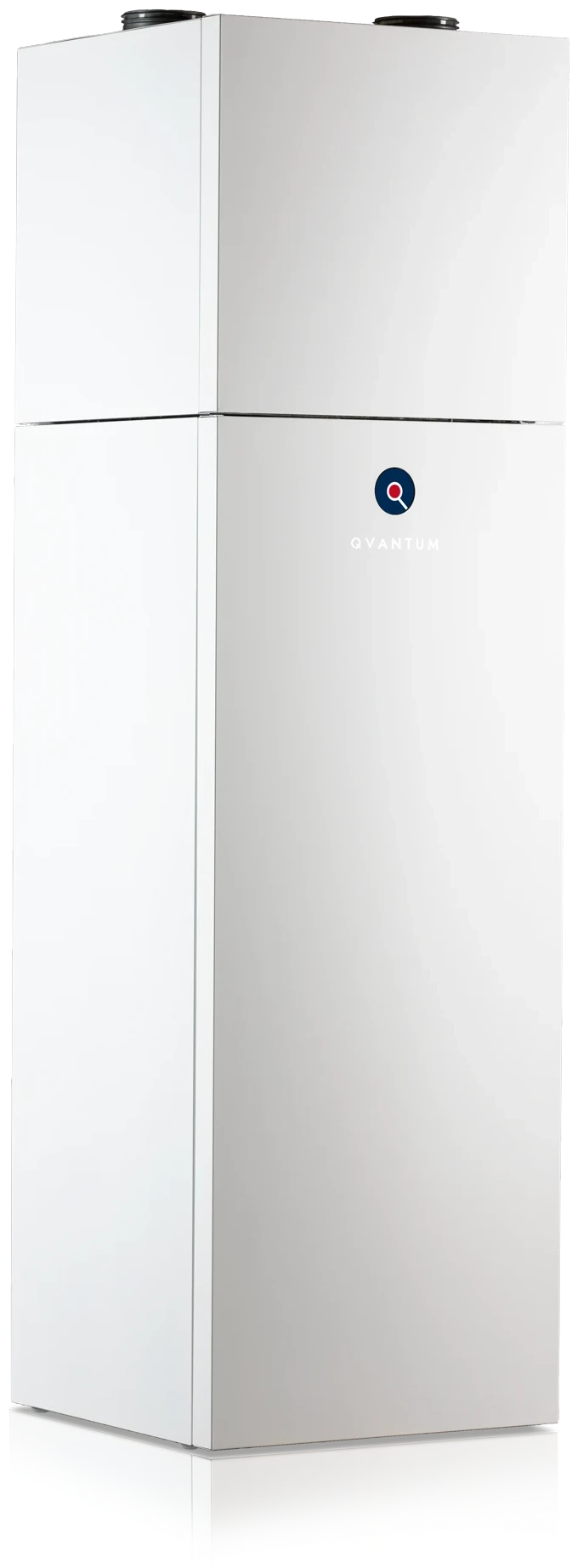
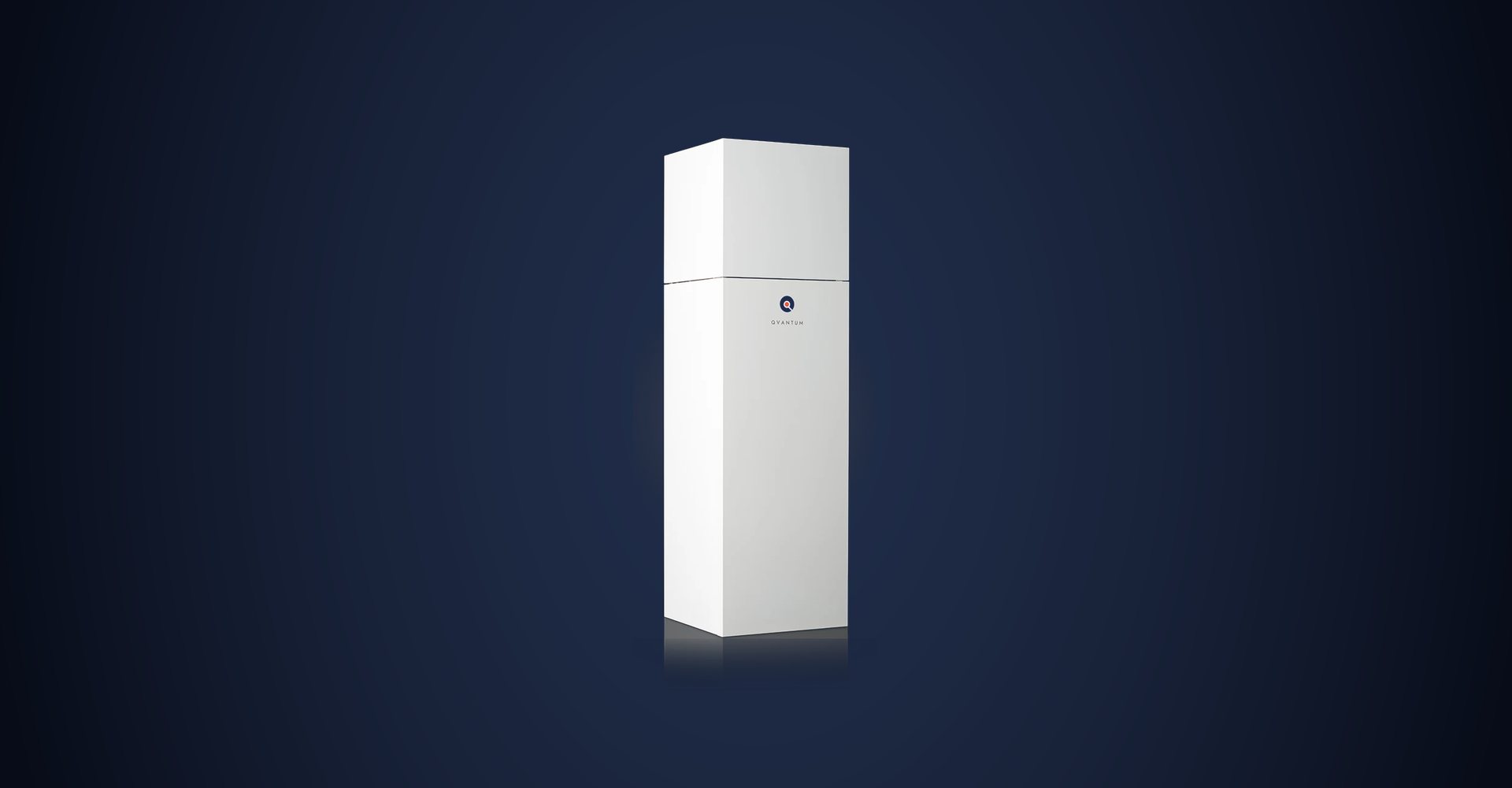
QE recovers the energy in the outgoing ventilation air and turns it into heating and hot water. 4 or 6 kW, for homes up to about 200 m².
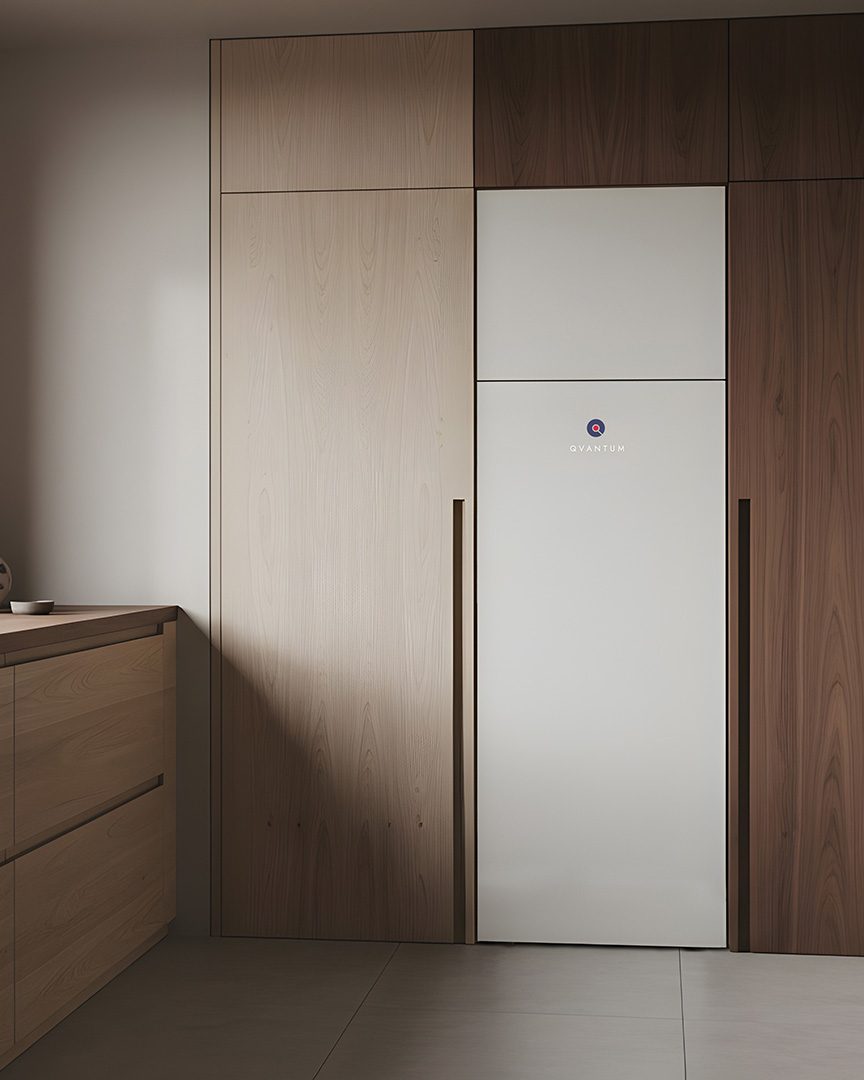
QE is more than a technical product. It is made to fit in, beside the kitchen or laundry cabinets, and to be something to feel proud of having chosen.
One cabinet, two sizes:
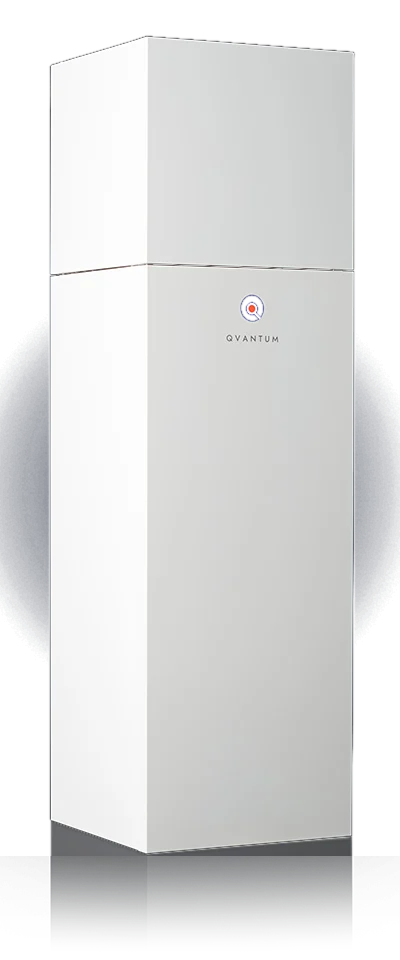
QE-4
QE-4 and QE-6 share one cabinet: 600 × 620 mm, 2,045 mm tall.
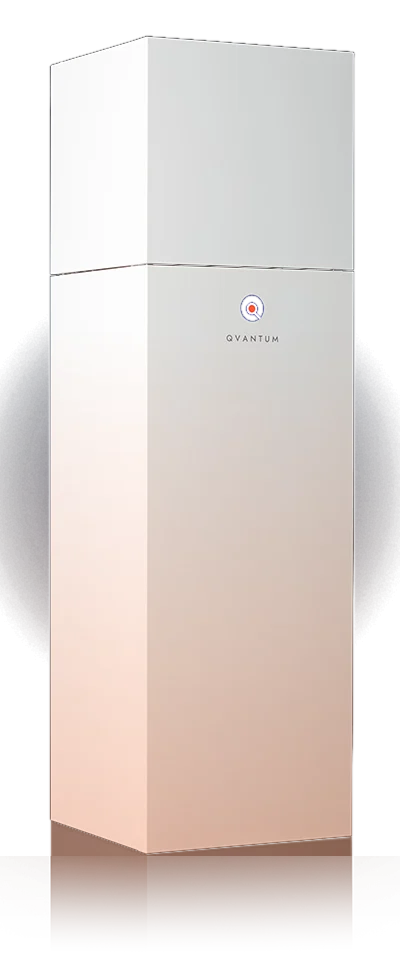
A single horizontal line divides the front into two calm white surfaces.
Straight, crisp edges that line up with the cabinetry around it.
600 mm wide, so it takes the place of a cabinet in a row of units.
Heating, hot water and ventilation in one product, 600 mm wide.
4–6 kW on an inverter-controlled compressor, against 1.5–2 kW in many conventional exhaust air heat pumps, so the electric booster stays off for more of the winter.
Heated via a heat exchanger the moment the tap opens, never stored in a tank, with no legionella risk.
Over-the-air updates bring new features for free, alongside spot price optimisation and remote diagnostics.
QE gives the home its heating, its hot water and its ventilation, from one white cabinet in the utility room or kitchen.
The used indoor air leaves through QE, which recovers its heat before it goes outside. Two connections of Ø 125 mm on top; 25–55 l/s for QE-4, 40–70 l/s for QE-6.
The built-in buffer tank can heat hot water to around 80 °C and works as a thermal battery, charged when electricity is cheap.
QE-4 and QE-6 both stand on 600 × 620 mm and are 2,045 mm tall, without the ventilation connections. They weigh 190 and 195 kg.
QE recovers the heat in the outgoing ventilation air, from 5 to 35 °C, and turns it into heating and hot water. Supply temperatures from 20 to 80 °C with the booster, and up to 63 °C without it.
QE-4 at 35 and 55 °C, average climate. QE-6 is A++.
From 39 dB(A) for QE-4 and 40 dB(A) for QE-6 (EN 12102), at the lowest output.
EN 16147, and up to 350 L in the Extra hot water mode.
QE-4, cold climate at 35 °C (EN 14825); 4.68 in average climate.
Upgrading an old exhaust air heat pump to QE is a good deal: the extra cost is often paid back before the warranty runs out, and lower electricity bills follow for many years. A compact cabinet, 600 mm wide, that fits in new build too.

QE's variable-speed compressor has far more output than a conventional exhaust air heat pump, which keeps the electric booster off for more of the winter.
The output of the internal electric booster, up to 5 kW, is easy to change in the app, and the heat pump can be power-limited as building regulations require.
The top cabinet hides the ventilation ducts above the heat pump for a neat, uniform finish, and lowers the sound in the room. It telescopes from 370 to 620 mm, or one section comes off for 300 mm. QS gives preheated supply air, and QT is the room display. All three are accessories. Top cabinet (in Swedish) →
The insulation requirement on the exhaust duct is the same as when the old heat pump went in, but the air in it gets colder, so the installer checks the insulation to keep condensation out.
QE draws the used air out of the house, recovers its heat in the heat pump, and keeps it in the buffer tank for heating and hot water.
The app, connectivity, remote diagnostics and automatic updates are included at no extra cost. An educational user interface and a low noise level make QE an asset to any home; control is in the Qvantum App, with QT, a wall-mounted room display, as an accessory.

Set how the heat pump runs through the week in the Qvantum App, to match how the home is actually used.
Automatic updates from the cloud bring new features at no cost, and they reach heat pumps that are already installed. Always up to date, always smarter. Anonymised operating data from installations across Europe makes every update smarter.
“It went from frustration to pure gratitude. Now everything works as it should, and a little more.”
Håkan Karlsson, after an update fixed his exhaust air heat pump without a service visit. Read the story (in Swedish) →
The heat pump avoids the most expensive hours and heats water when electricity is cheapest, with no loss of comfort.
By responding to fluctuations in energy availability, flexready® heat pumps ease grid strain, lower energy costs and improve system stability. Open to partner energy platforms, so heating can follow electricity prices and grid tariffs and work together with solar panels, home batteries and EV charging.
Fresh cold water is heated in a heat exchanger the moment you open the tap. It never stands in a tank, and no corrosion protection has to be chosen by water quality.
Always connected, so predictive maintenance and service can happen at a distance.
With spot price optimisation activated, QE follows the hourly electricity price: it charges the buffer tank when power is cheap and runs on stored heat when prices peak.
Illustrative example. Actual timing follows the local electricity price or tariff and the settings in the Qvantum App. Indoor comfort stays the same all day.
Stellan and Monica Lindsjö's old heat pump gave up in the middle of winter, while they were away skiing. Qvantum had a new exhaust air heat pump in stock, and it was delivered and installed in record time.

“Just as promised, our costs are lower.”
Stellan, on replacing the old heat pump with one from Qvantum
Quotes translated from Swedish. Read the full story (in Swedish) →
Replacing an exhaust air heat pump?
What homeowners and installers usually ask about QE.

QE-4 and QE-6 share the same cabinet. QE-4 is for a recommended airflow of 25–55 l/s and QE-6 for 40–70 l/s; both suit homes up to about 200 m². The installer picks the size by the home's ventilation and heat demand.
That is what it is made for. Older, conventional exhaust air heat pumps often have only 1.5–2 kW on the compressor and lean on the electric booster in winter. QE's variable-speed compressor gives 4–6 kW, and the extra cost of the upgrade is often paid back before the warranty runs out.
Declared load profile XL and 235 L of hot water at 40 °C (EN 16147), or up to 350 L in the Extra hot water mode, depending on system settings and tap flow. Fresh cold water is heated in a heat exchanger as the tap opens, so it never stands in a tank.
Sound power level 39–52 dB(A) for QE-4 and 40–54 dB(A) for QE-6 (EN 12102). In the installation room, 36–48 and 36–50 dB(A), with 4 dB of sound damping; the room itself affects the figure.
SCOP 4.68 (QE-4) and 3.84 (QE-6) in average climate at 35 °C, energy class A+++ and A++. With spot price optimisation activated, the buffer tank is charged when electricity is cheap and used when prices peak.
R513A, with a GWP of 631: 1.2 kg in QE-4 and 1.35 kg in QE-6, equal to 757 and 852 kg of CO₂ equivalent.
QE handles the home's exhaust ventilation, so its filters need changing now and then. Replacement filters are available from Qvantum.
What QE changes for the installer, from the first visit to service.
| USP | What it means | Impact on the installer's business |
|---|---|---|
| Variable-speed compressor | 4–6 kW on the compressor, against 1.5–2 kW in many conventional exhaust air heat pumps. | A clear upgrade to offer at every replacement. |
| Booster set in the app | The booster, up to 5 kW (1 + 2 + 2), is changed in the app, and the heat pump can be power-limited to building regulations. | No extra visit to adjust the output. |
| One cabinet, two sizes | QE-4 and QE-6 are both 600 × 620 × 2,045 mm and weigh 190 and 195 kg; ventilation connections Ø 125 mm. | One product to learn, whatever the house. |
| Top cabinet, 300 or 370–620 mm | Hides the ventilation ducts up to the ceiling and lowers the sound in the room. Telescopic from 370 to 620 mm; one section comes off for 300 mm. | One accessory fits most ceiling heights, with a finished look at handover. |
| Fresh hot water via heat exchanger | No legionella risk, and no corrosion protection to choose by water quality. | Fewer site-specific choices. |
| Digital installation guide | The free Qvantum App guides the installer through the installation step by step. | A simple installation, the same way every time. |
| Remote access with QService | Free for installers: remote access, predictive maintenance and real-time support. | Saves time and travel, and gives confidence in every installation. |
| Updates over the air | New features and improvements reach installed heat pumps automatically, and support and optimisation happen at a distance. | Fewer unnecessary service visits, and a customer whose heat pump gets better over time. |
| Warranty registered in the app | The warranty is registered directly in the app at installation. | A quick, easy handover to the homeowner. |
“The software is in a class of its own. You are guided through the installation, and even an installer doing it for the first time understands straight away.”
Andréas, AM Construction, which installed QE in all 49 terraced houses at Aggerudsvikarna
Hot water is heated through a heat exchanger rather than taken from the tank, so corrosion protection is not even a question. And when something comes up, Qvantum's support connects to the heat pump while the installer stands in front of it. Quote translated from Swedish.
“With Qvantum we have found a partner that really understands what matters on site: technology, reliability and real support.”
Project manager, BW Mechanical, installer at the former Price's Candle Factory site
177 new homes by the developer Ghelamco, each with its own exhaust air heat pump and the QS supply air unit. Every household controls its own energy use and is billed fairly for it, and hot water is distributed without unnecessary heat losses. Quote translated from Swedish.
Key figures for QE-4 and QE-6, from Qvantum's technical data on qvantum.com.
Nominal heat output (Pdesignh), average and cold climate
Energy class, QE-4 at 35 and 55 °C
Hot water at 40 °C, EN 16147
Declared load profile, water heating class A
Shared by both: 600 × 620 × 2,045 mm (height without the ventilation connections and feet); ventilation connections Ø 125 mm; rated voltage 400 V 3N~ or 230 V 1N~, 50 Hz; electric booster up to 5.0 kW (1 + 2 + 2); exhaust air operating range 5–35 °C; heating medium 20–80 °C with the booster, up to 63 °C without it; 235 L of hot water at 40 °C (EN 16147), up to 350 L in the Extra hot water mode, at a tap flow of 10 l/min and 10 °C incoming cold water; water heating class A, declared load profile XL. Refrigerant R513A, GWP 631. Sound pressure in the installation room with 4 dB of sound damping. RSK numbers for the accessories in Sweden: QS 625 91 34, top cabinet 300–620 mm 625 91 26.
Run a project through the calculation tool, and share the customer page with homeowners and installers.